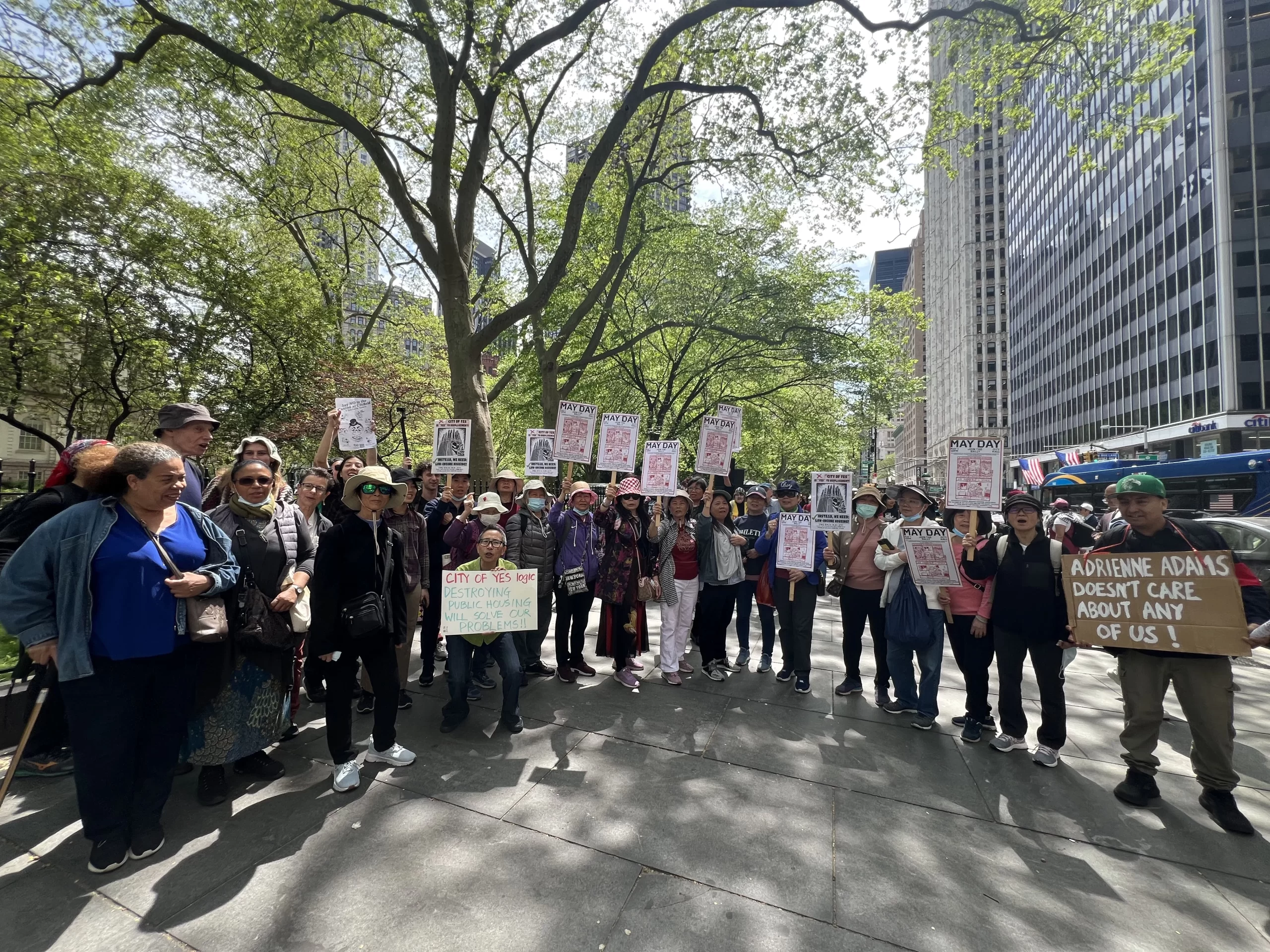
In a statement released by the arrestees, they said, “Today we were joined by home attendant supporters in court. The judge heard what it is that we are fighting for – the end to the violent, 24-hour workday that CPC perpetuates. In the end, the judge dismissed all the charges.”
“CPC tried to intimidate workers by using police violence. But it failed! Workers are more angry and determined than ever and vow to continue to picket CPC until they pay back their hard-earned wages!”
They urge people to join the weekly picket in front of CPC’s luxury building at 45 Suffolk St, Wednesdays, 10am-11:30am.
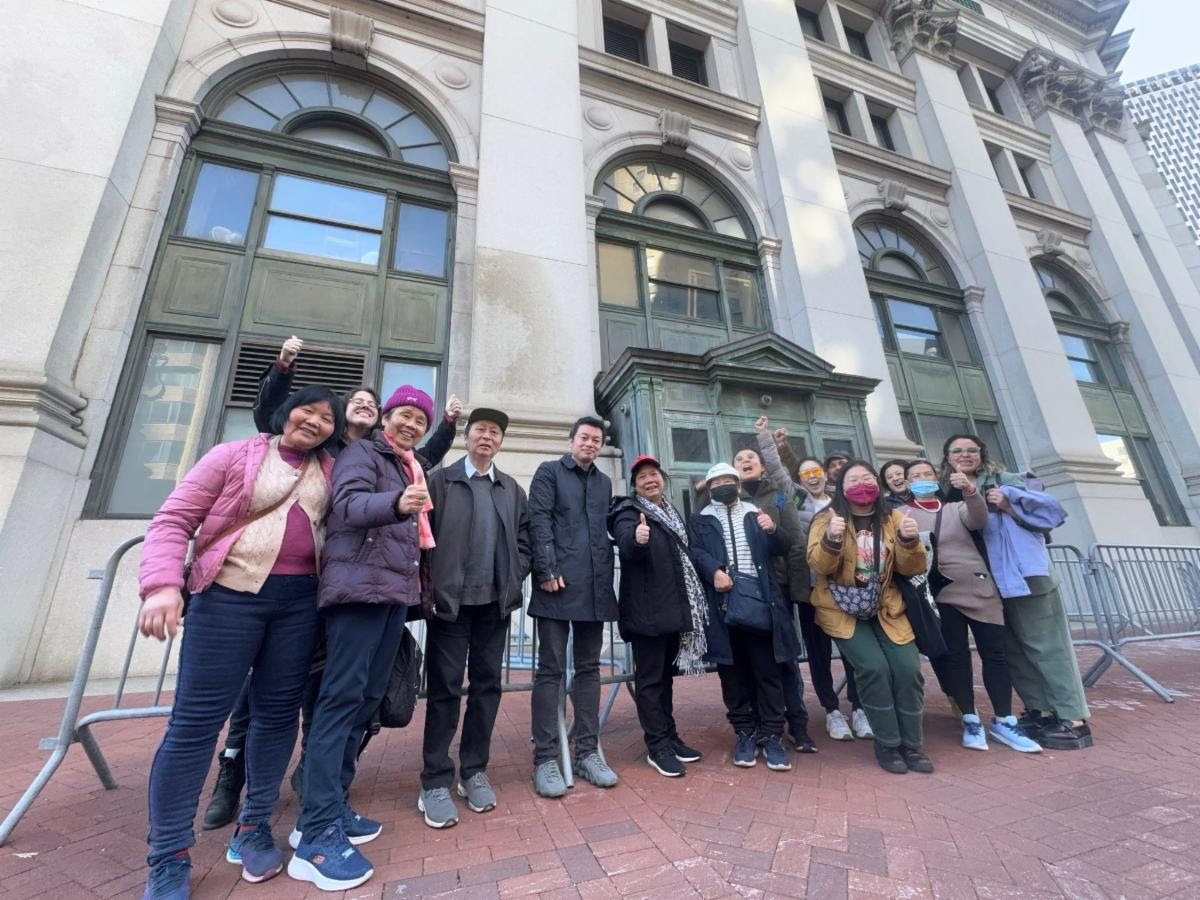
“Tonight we have over a hundred of fellow home care workers protesting,” said Ai Yu Zeng, a home care worker who was arrested. “All we’re doing is exposing CPC’s lies! We’re condemning their abuse of us immigrant women with continued 24-hour workdays. Now, CPC not only refuses to pay us back the $90 million stolen wages, but even calls the police to arrest me on the spot! When young people saw that and condemned the police’s violence against me, they, in turn, were also arrested. How evil!”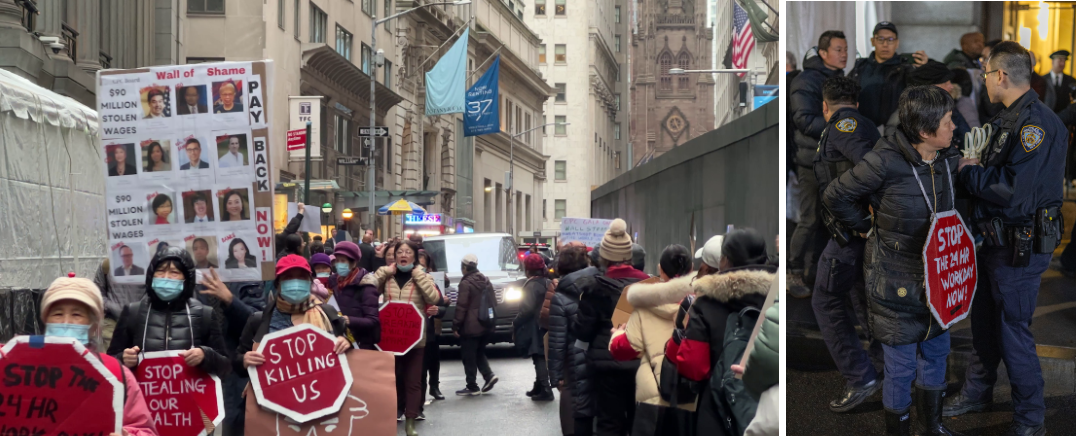
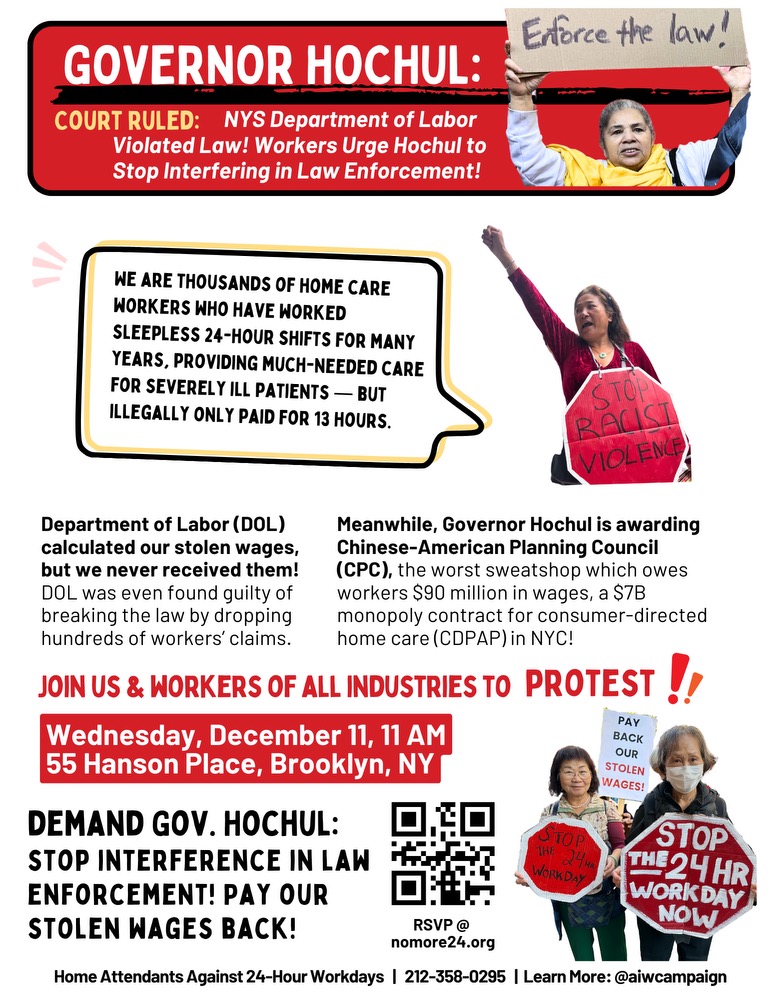
While many home care agencies have already implemented split shifts, CPC still assigns 24-hour home care shifts and just received contracts worth $7 billion a year from Governor Kathy Hochul to monopolize the consumer-direct home care market in NYC, Long Island, and Westchester. Protestors were peacefully picketing on the sidewalk when CPC sent violent cops to suppress protesters and arrest elderly Asian home attendants.
“Cops moved in shortly after CPC sent someone to rob a journalist of her live-streaming phone from mid-air, so as to abruptly shut down the media coverage of the protest,” said Sarah Ahn, who was also arrested. “Cops went after the elderly Asian women home attendants and the young people who were using their phones to document the arrests!”
Photos show CPC Chief of Staff Alice Wong sent a thug to violently snatch a journalist’s phone and walk into the gala with it so the brutal arrests could not be recorded. The perpetrator was Ken Paskar, friend of the corrupt former Assembly Member Sheldon Silver and CPC’s lawyer Alan Gerson. Under people’s continuous outcry over police’s protection of CPC, the police were eventually pressured to arrest Ken Paskar. High-level elected officials crossing the picket line included Chuck Schumer and Grace Meng. 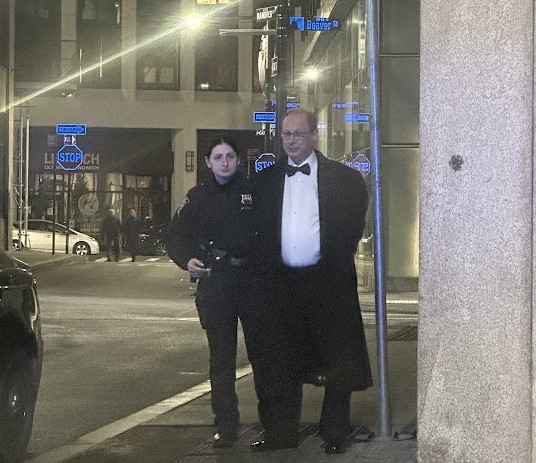
(Ken Paskar, who was sent by CPC to snatch the reporter’s phone, was arrested)
“This is CPC’s true face, as they think they are above the law with Governor Hochul’s backing. They’re also run by a board that consists 90% of bank, real estate, and insurance company executives. Instead of paying back wage theft, they are raising more money with their allies of casinos, DoorDash, and lobbyists to oppress immigrant communities,” said Kathy Lu, a working mother who was also arrested.
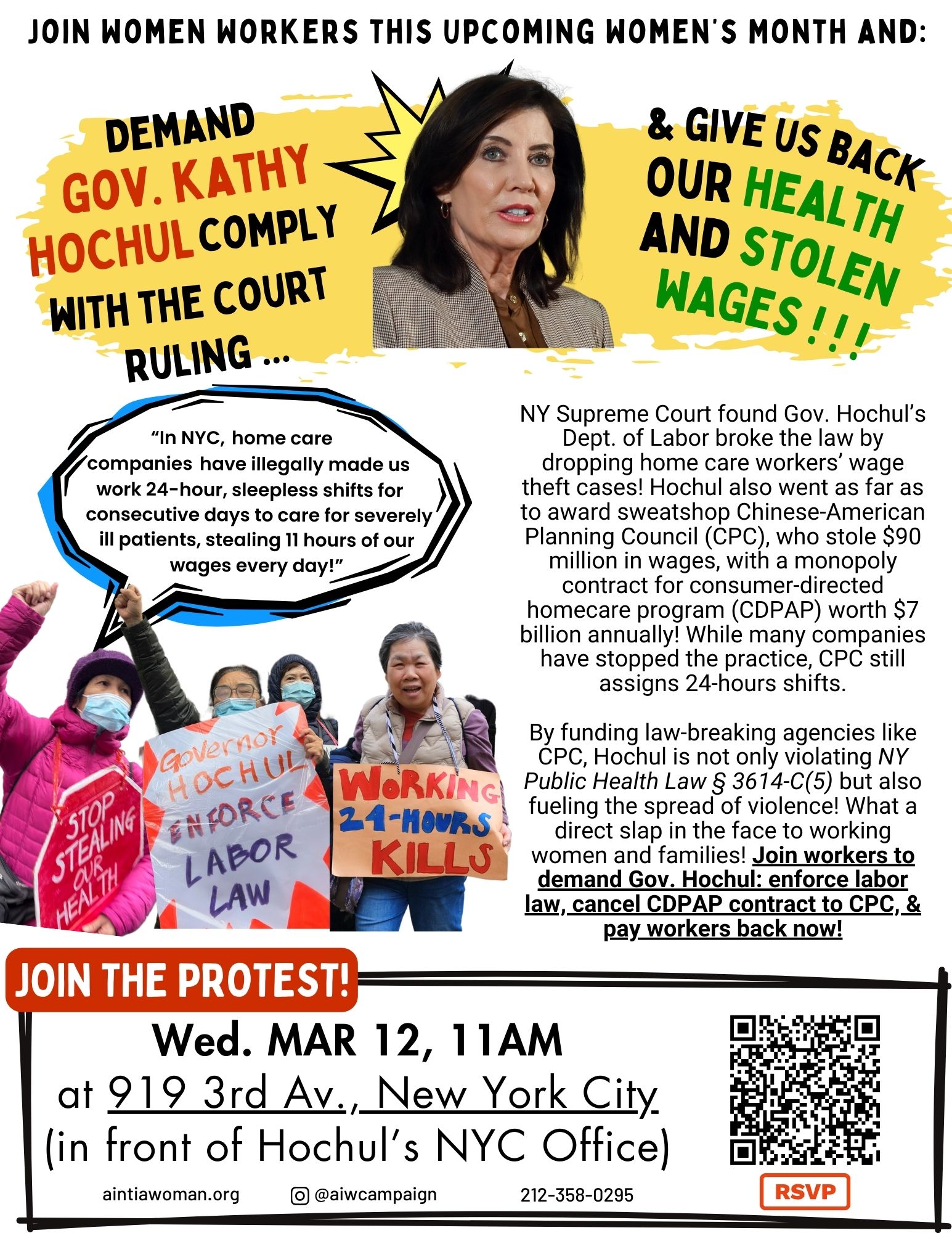
CPC’s violent repression did the opposite of stopping the protest, as home attendants and supporters became more determined and continued to protest for more than an hour, and their furious chants were heard all over Wall Street. The protesters ended by strongly condemning the unlawful crackdown. They also called on everyone to join the protest on March 12 at 11am in front of Governor Hochul’s office (919 3rd Ave) to demand she stop colluding with CPC, enforce the law to pay back stolen wages and end the 24-hour workdays.

|
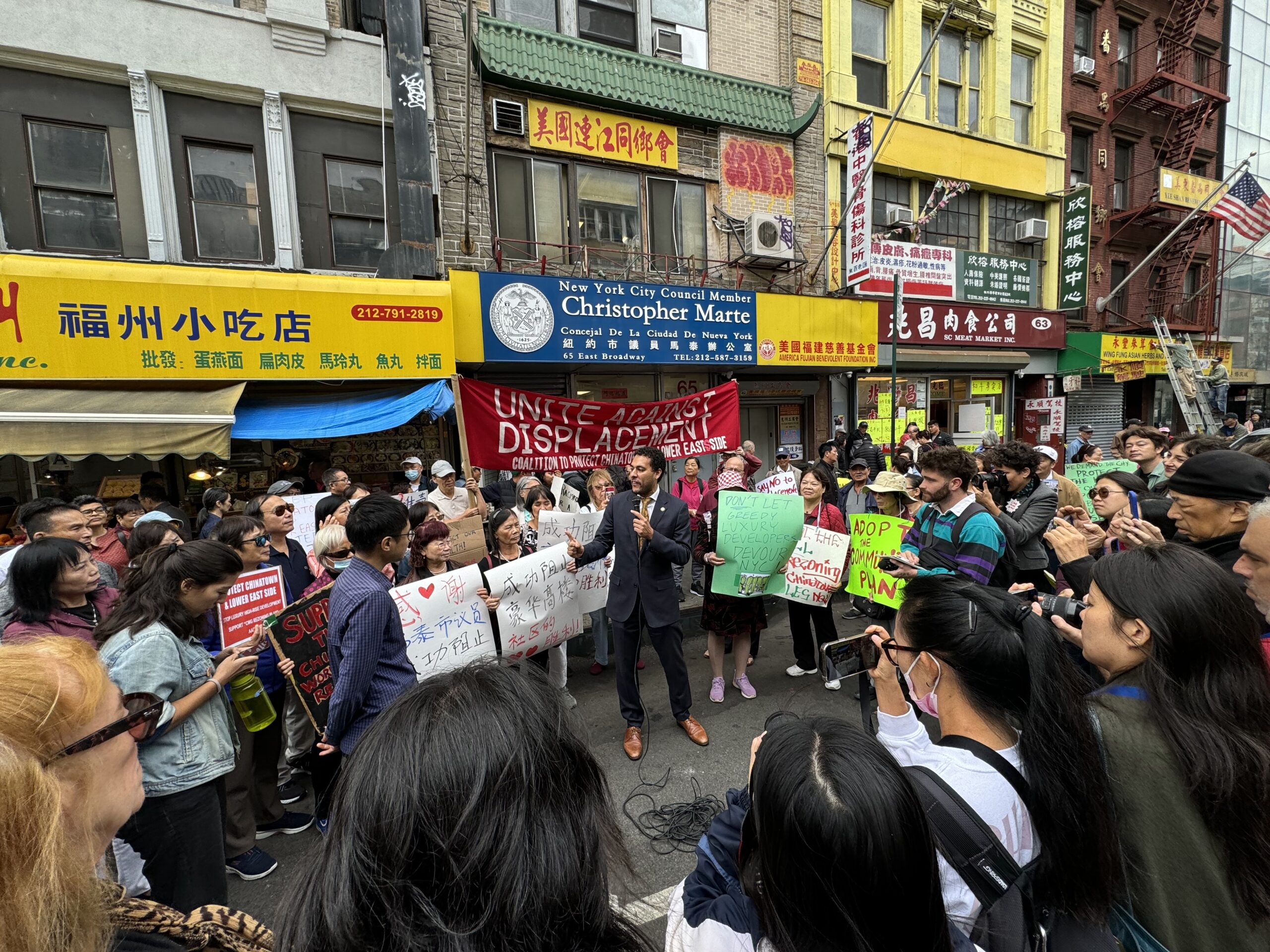
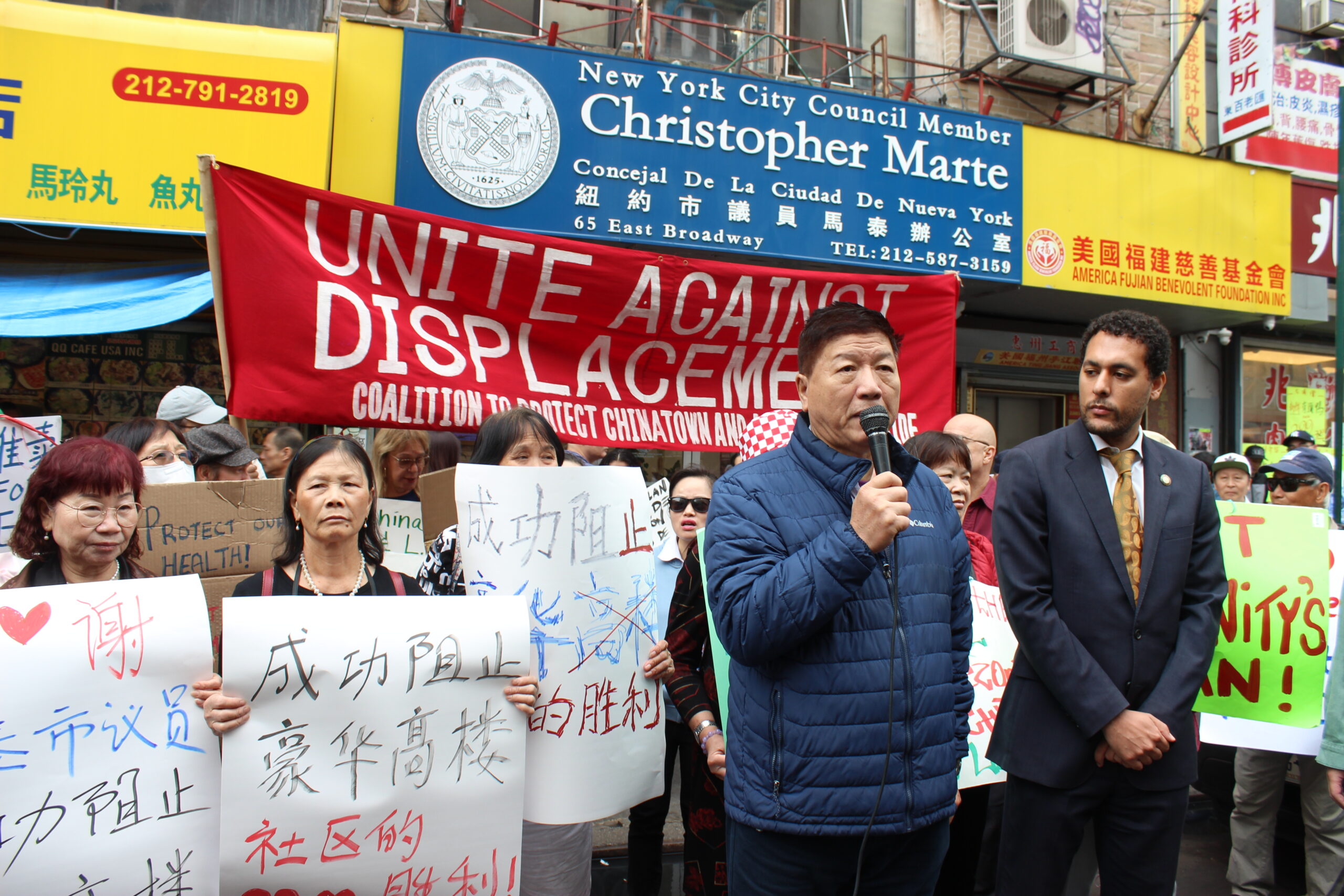 David once again defeats Goliath! Community members of Chinatown, Lower East Side, SoHo and other downtown areas gathered last Tuesday 9/24 with Council Member Christopher Marte to celebrate our victory against a developer’s latest attempt to build luxury high rises on the Two Bridges waterfront.
A month ago, Chetrit, the developer and owner of 265-275 Cherry Street, announced that they were in the final stages of bringing on a development partner to help finance their megatowers project, and planned to break ground within a few weeks. Our community, with Council Member Marte’s leadership, swiftly condemned Chetrit’s greed in pushing this project and their disregard for people’s lives. Three weeks later, the tide has quickly turned in the community’s favor: Chetrit, abandoned by their development partner, is backing out of the project and has defaulted on their loan. The lot now heads to the auction block.
Chetrit’s surrender is the latest victory in our community’s years-long fight against the megatowers. By organizing with Two Bridges residents, neighbors from the Lower East Side and Chinatown, as well as workers, students and small businesses who are a part of these communities, we have proven that a unified community can triumph over the greed of billionaire developers.
These two towers, each 60- to 80-story tall, were planned to be built right next to two existing buildings that provide affordable housing. If built, they would damage the structure of the buildings, threaten the health and safety of their residents and drive up real estate taxes and rents in the surrounding area. In 2017, with the support of former Council Member Margaret Chin, developers proposed to build these luxury megatowers. Chin sent a letter to residents saying they “could not stop the towers from going up” and at best they could ask for some crumbs from the developers. Since then, multiple developers have taken over the project only to abandon it, due to consistent community organizing against displacement.
Mr. Chen, a longtime Two Bridges resident, said: “These developers don’t care about the people, they only care about money. But because our community is very united, and because we have a very good City Council Member, Chris Marte, who stands with the tenants and stands with the community, we are able to fight back!”
Council Member Chris Marte said: “Today is a testament to the will of the people. It’s a major win for our neighborhood, for our city. When people on the street say this is just the way it is, there’s nothing we can do, you’re going to say: however, in Two Bridges, we took on developers & won!”
In celebrating this victory, community members call on the City to pass the Chinatown Working Group Rezoning Plan, which would stop luxury high-rises and limit real estate speculation in Chinatown and the Lower East Side by capping the height of new developments and mandating truly affordable housing.
Our community sends a clear message to any big developers threatening to take over our neighborhoods: do not build luxury towers that destroy people’s lives, or else you will encounter our united opposition and lose.

It is wrong for the City or State government to turn hotels into shelters or build shelters to solve the problem of homelessness. Not only is it unfair to low-income communities of color, but it is also not good for homeless people and families, and does not solve their housing and livelihood issues at all. We want the government to stop wasting taxpayers’ money fattening up the rich and real estate developers who run hotels and shelters. We demand the State and City governments use public funds to build low-income housing for working people, who are increasingly unable to afford rising rents, instead of paying big developers to build only luxury high-rises and hotels on one hand, and homeless shelters on the other.
For example, the vacant land next to Confucius Plaza and NYCHA can be used to build low-income housing. Yet after the 1960s, the Federal government has hardly built any public housing. Doesn’t the government know that the population is growing and the gap between the rich and the poor is widening? Or does it only know to let real estate developers build high-rises to make more money?
We have reservations about the anti-shelter movement on 86th Street in Brooklyn, which criminalizes homeless people. Opposing homeless shelters but only caring about themselves and not homeless people, they are pitted against other communities by the City government and big developers. This only benefits big developers. Their criminalization of homeless people is similar to Trump’s criminalization of immigrants. It makes sense that the Democratic Party tends to support homeless shelters and the Republican Party tends to oppose shelters! Support or opposition falls into the trap of the ruling class (in New York City, this is basically the real estate and financial capital class). Trump and the Republican Party claim to only target undocumented immigrants, but in fact, they are criminalizing all immigrants! The Democratic Party claims to care about undocumented immigrants, but in fact it is doing everything possible to keep immigrants as an underclass of labor. Immigrants are pitted against the so-called native workers. Whether it is the Republican or Democratic Party, the main line of their policies is to divide the working class, deepen racial tension and deepen exploitation.
The current anti-shelter movement on 86th St is not really against shelters, but only against shelters near their homes. This movement can easily be used by those with ulterior motives or misunderstood as anti-Black or anti-homeless people and families. We shouldn’t let the Chinese community be isolated, which will bring only harm to us Chinese. In case you have doubts about this, Mayor Adams has already said that the anti-shelter movement on 86th St is against single Black men. And the Sing Tao Daily, which has always encouraged big developers and home care agencies to abuse our community , has promoted the 86th Street movement every day. This makes even more clear that this movement does not help our community
We must break the isolation of the Chinese community, care about the conditions of the residents in the shelter, and unite across race to demand the government build low-income housing and stop helping big developers from displacing our communities.
Chinese Staff and Workers’ Association
212-334-2333
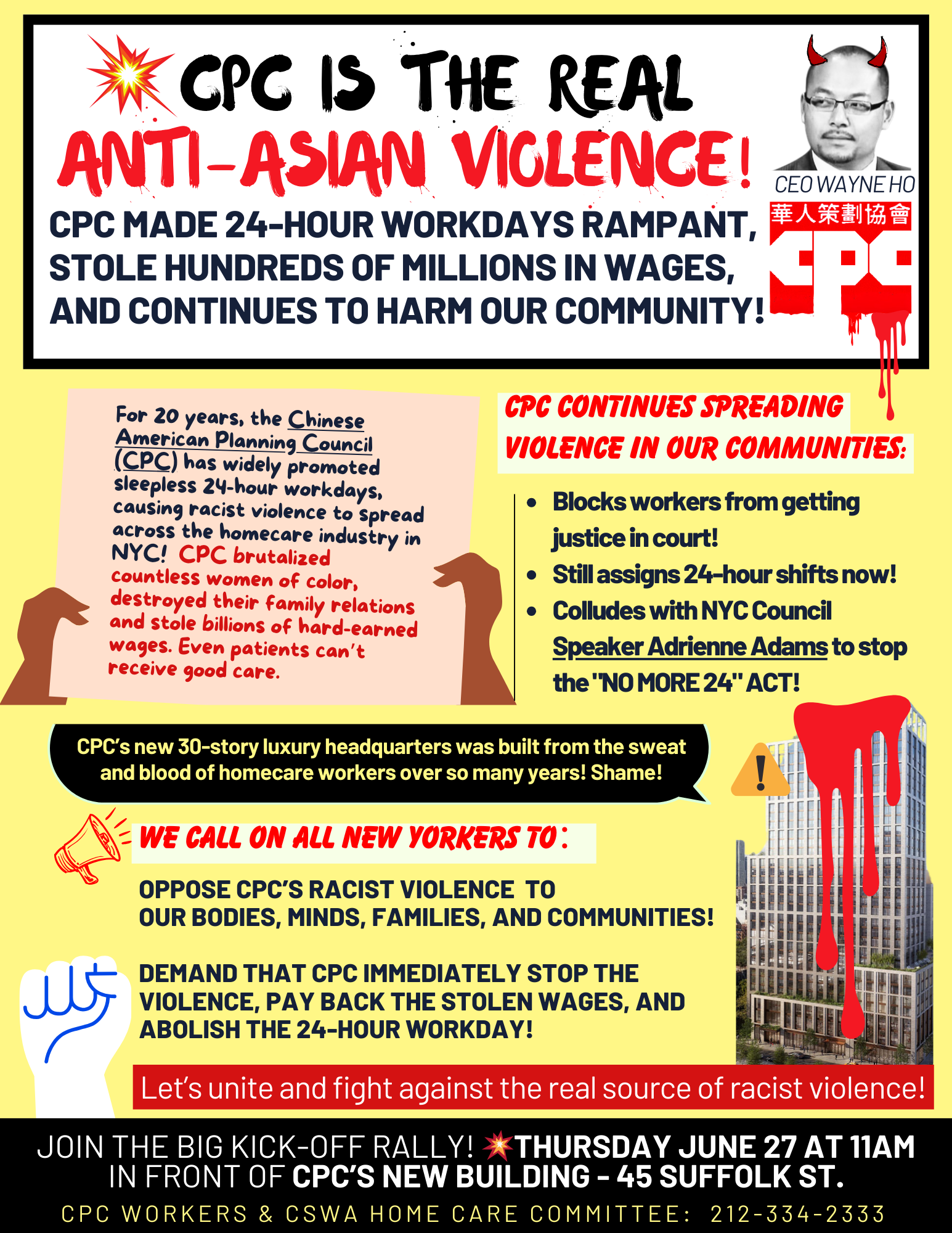
The New York State Government’s legislation against hate crimes was included in this year’s state budget. This bill will include more illegal behaviors to be defined as “hate crimes”. This is good news. However, some racist institutions hold the banner of “anti-racism” to cover up and continue their racism and violence. For example, recently, the Chinese-American Planning Council (CPC) is holding a “Stop Asian Hate” film screening and discussion at the Museum of Chinese in America (MOCA) on May 4.
The so-called “non-profit organization” CPC has taken the lead in forcing home care workers into 24-hour workdays and stealing over $100 million wages from them. It recently moved its headquarters to a new 30-story luxury high-rise in the Lower East Side. The 24-hour workdays are inhumane. Most of the home attendants are Chinese and other women of color. They are forced to work 24 hours a day for a long time, which causes serious damage to their physical and mental health and family relationships. While CPC is committing this kind of violence against women of color, it’s asking the government for funding to fight anti-Asian violence! As the saying goes, birds of a feather flock together. MOCA sells out the community by taking the City’s $35 million to support its construction of a new jail in Chinatown. It has long been notorious and boycotted by the community for many years. How dare these institutions carry out activities in the name of “Stop Asian Hate”! Aren’t they the ones who should stop their own hatred against Asians?
CPC’s event also attracted some elected officials to participate. We call on these elected officials to keep their eyes open and stand with the community against racism by boycotting these blood-sucking institutions.
Vincent Cao
Chinese Staff and Workers’ Association